
How TDGC2J Single-Phase Contact Voltage Regulator work?
One Handwheel, and the Job Isn't That Complicated
Some situations don't need an automatic stabilizer chasing the grid, or a servo motor adjusting back and forth. What's needed is one thing: slowly dial the voltage up from zero, stop at the right spot, and let the equipment run. Dialing in heating power in a lab, testing motor speed on a workshop floor, running a demonstration experiment on a classroom lectern — what these scenarios share is that voltage requirements aren't fixed, changes aren't frequent, and the person operating it is right there. The TDGC2J single-phase contact voltage regulator does exactly this job.
Toroidal Core Plus Carbon Brush: Simple Structure, but It Works
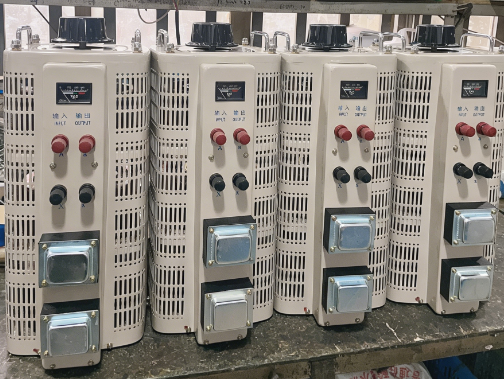
The TDGC2J Single-Phase Contact Voltage Regulator's principle isn't complicated. A coil is wound evenly around a toroidal core, the coil surface is ground to expose a smooth conductive face, and a carbon brush slides along that face under spring pressure. Turn the handwheel, the brush moves along the coil surface, changing the turns ratio between primary and secondary, and output voltage changes smoothly. Input 220V, output continuously adjustable from 0 to 250V — no step jumps.
No waveform distortion is a real advantage of this structure. Output waveform follows input with no added distortion. For lab equipment requiring pure sine wave power, this is more solid than many automatic stabilizers.
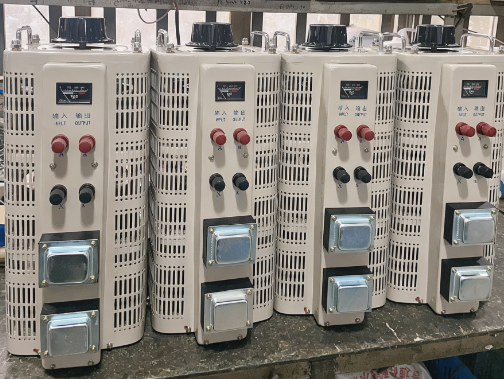
Capacities from 0.2kVA to 40kVA: Covering "Small-Power Regulation"
The TDGC2J Single-Phase Contact Voltage Regulator capacity range is fairly broad: 0.2, 0.5, 1, 2, 3, 5, 7, 10, 15, 20, 30, and 40kVA. The small 0.5kVA model measures roughly 14×13×13cm and weighs around 4 kilograms — it sits on a lab bench without taking up space. The 10kVA unit measures 31×24×41cm and weighs 36 kilograms — it takes two people to lift or needs to be fixed to a bench. From 30kVA up, units are floor-standing, and you'd better figure out where to put one before moving it.
Efficiency is rated above 90%, with temperature rise held within 60°C. These numbers aren't spectacular, but they're normal for this price and this structure.
An Easily Overlooked Detail: What the "J" Means
The "J" in the TDGC2J model designation, according to some manufacturers, indicates an economical transitional product. In appearance, the TDGC2J uses the older round (hexagonal) structure, while the TDGC2 uses the newer square structure. The electrical principle is the same and the output range is identical — the difference is mainly tooling and appearance. If procurement has no special requirements on form factor, the TDGC2J usually offers better cost-performance.
A Few Things to Watch During Use
The carbon brush is a wear item. Over time it wears down, and when wear becomes severe, contact degrades — output voltage jumps or sparks. Check brush condition periodically; replace with the same specification when worn. After replacement, wrap zero-grade sandpaper underneath and turn a few times to smooth the contact surface. The coil surface should also be kept clean — burn marks can be wiped off with cotton cloth and alcohol. These maintenance steps aren't complicated, but skipping them noticeably shortens regulator life.
Output current must not exceed rated value. Exceeding it doesn't mean immediate failure, but service life drops, and severe cases burn the coil directly. Also, regulators must not be paralleled — the manual states this clearly. Don't think two units in parallel can drive a bigger load.
When moving it, grab the handle or lift the whole unit — don't pull on the handwheel. The handwheel connects to the carbon brush and drive mechanism, and improper force can knock it out of alignment.
Applications Are Fairly Clear
The TDGC2J Single-Phase Contact Voltage Regulator's main battlefield is situations requiring manual voltage adjustment but not automatic tracking. Lab heating mantles and electric furnace temperature control, motor testing and speed adjustment on the workshop floor, voltage-regulated power for school physics experiments, small-power dimming and temperature control circuits in chemical plants. What it doesn't do is equally clear: it can't stabilize voltage automatically — if grid voltage changes, it won't compensate on its own. It can't serve as an isolation transformer — the auto-transformer structure has primary and secondary connected. And it can't handle surge loads — high motor starting current will overwhelm both brush and coil.
When specifying, leave some margin based on the load's actual power — especially for motor loads, don't cut it too close. Confirm input voltage is 220V, connect terminals A and X to the power source, a and x to the load, and tighten the grounding terminal. For the rest, just turn the handwheel slowly.
Related News
- When can we find TSGC2 Contact-type Voltage Regulator?
- Why is Online Soft Starter Convenience or Trouble?
- When use Three Phase High-power Voltage Regulator?
- When Voltage Drops to 160V, Can TND Fully Automatic AC Voltage Stabilizer Still Work?
- Where is BK Industrial Control Transformer?
- Why SBK Isolation Transformer is important?
Leave me a message
News Recommendations