
When use Three Phase High-power Voltage Regulator?
Sometimes What's Needed Isn't "Stabilization" — It's "Adjustment"
Bring up voltage regulation on an industrial floor and eight out of ten people think of automatic stabilizers first — grid drops, it compensates; grid rises, it bucks; no one needs to watch it. But there's another category of demand that's always been there and is a bit different: slowly raising voltage on a test bench to check equipment withstand voltage curves, manually adjusting power for furnace temperature control, smoothly changing output voltage on dimming circuits, gradually stepping up voltage during motor testing. What these scenarios share is that voltage requirements aren't fixed, changes are controlled by a person, and the operator is standing right there watching the meter. The three-phase voltage regulator does exactly this job.
Contact-Type Structure: Simple, but It Works
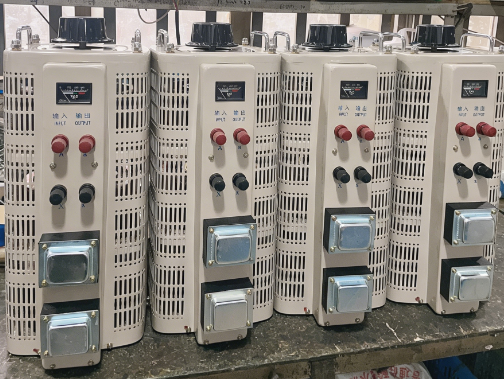
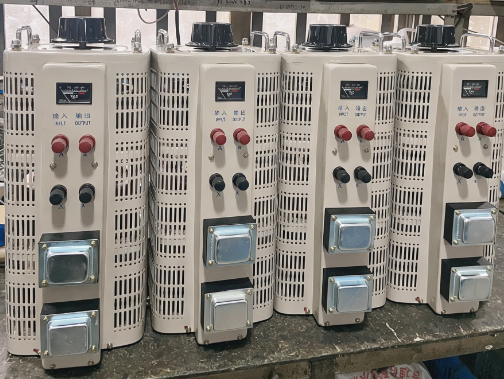
The mainstream form of three-phase voltage regulators is contact-type. Three single-phase regulators are assembled on a common shaft, carbon brush holders mounted on the same central axis. Turn the handwheel or drive the servo motor, and the three brushes slide synchronously along the polished surfaces of their respective coils, changing the turns ratio between primary and secondary. Output voltage then varies smoothly and steplessly within the regulation range.
Input 380V, output typically continuously adjustable from 0 to 430V. No waveform distortion is a real advantage of this structure — output waveform follows input with no added distortion, friendly to test equipment and precision instruments.
Capacities cover 1.5kVA up to several tens of kVA, with the standard 6kVA, 9kVA, 15kVA, 20kVA, and 30kVA ranges seeing relatively high shipment volumes. Small benchtop models fit in a corner of the test bench; larger floor-standing units need their location planned in advance.
Manual or Motorized: Depends on Operating Frequency
Three phase high-power voltage regulators come in manual and motorized types. Manual versions have the handwheel driving the brush directly — simplest structure, lowest price, suitable for scenarios where voltage adjustment isn't frequent and the operator is right there. Turning the wheel a few times for a withstand voltage test in the lab, or adjusting once for a classroom demonstration — manual versions are entirely adequate.
Motorized versions add a servo motor and controller, allowing local push-button operation or remote closed-loop control. For production lines requiring frequent voltage adjustment, or where the regulator is mounted deep in a cabinet out of arm's reach, motorized versions save trouble. The trade-off is higher price, an extra motor and control system, and one more maintenance point.
Which to choose isn't about how advanced the technology is — it's about actual operating frequency and location.
A Few Things You Can't Avoid During Use
The carbon brush is a wear item. Over time it wears down, and when wear becomes severe, contact degrades — output voltage jumps or sparks. Check periodically; replace with the same specification copper-graphite composite brush when worn. After replacement, wrap zero-grade sandpaper underneath and turn a few times to smooth the contact surface. Burn marks on the coil surface can be wiped off with cotton cloth and alcohol. These maintenance steps aren't complicated, but skipping them noticeably shortens regulator life.
Three-phase voltage regulators must not be paralleled — the manual states this clearly. Don't think two units in parallel can drive a bigger load. Input voltage must not exceed rated value, and when not in use, dial output to zero before cutting power. When moving it, grab the handle — don't pull on the handwheel. The handwheel connects to the carbon brush and drive mechanism, and improper force can knock it out of alignment.
Grounding must be reliable. If the regulator enclosure isn't grounded and something goes wrong between brush and coil, the risk of the enclosure becoming live is very real.
Different Jobs from Automatic Stabilizers
Three phase high-power voltage regulators and three-phase automatic stabilizers often get mentioned together, but they don't do the same thing. How much voltage a regulator outputs is decided by the person — if grid voltage changes, it won't compensate on its own. How much voltage a stabilizer outputs is decided by the setpoint — however the grid swings, it tracks on its own.
Before specifying, think clearly: do you need an adjustable voltage source, or a power supply that stays at 380V no matter how the grid changes? If it's the former, a voltage regulator is the right answer — simple, direct, low cost. If it's the latter, a regulator won't solve the problem — you need a stabilizer.
Another easily confused point is isolation. Contact-type three-phase voltage regulators are auto-transformer construction — primary and secondary share windings, with no electrical isolation. If the equipment needs isolation, an isolation transformer must be added downstream, or choose an integrated model with built-in isolation.
Applications Are Fairly Clear
The main battlefield for three phase high-power voltage regulators is situations requiring manual intervention in voltage adjustment. Voltage-regulated power for motor and electrical apparatus test benches, power adjustment for furnaces and heating equipment, front-end voltage regulation for rectifier equipment, dimming control for lighting circuits, and various voltage regulation needs in laboratories, schools, and research institutes.
What it doesn't do is also clear: it can't stabilize voltage automatically, can't replace a UPS for momentary outages, and can't provide electrical isolation. Get these boundaries straight, and selection won't go astray.
Related News
- When can we find TSGC2 Contact-type Voltage Regulator?
- Why is Online Soft Starter Convenience or Trouble?
- How TDGC2J Single-Phase Contact Voltage Regulator work?
- When Voltage Drops to 160V, Can TND Fully Automatic AC Voltage Stabilizer Still Work?
- Where is BK Industrial Control Transformer?
- Why SBK Isolation Transformer is important?
Leave me a message
News Recommendations