
When Voltage Drops to 160V, Can TND Fully Automatic AC Voltage Stabilizer Still Work?
Anyone who's spent time in township shops, aging factory districts, or at the end of a distribution grid knows this situation well: peak hours hit, fluorescent lights struggle to start, air conditioner compressors cycle on and off, and power indicator lights on precision instruments start flickering. A meter reading shows line voltage down at 170V or lower. The equipment isn't broken, protection settings are correct — there's just not enough "juice." The TND series fully automatic AC voltage stabilizer targets exactly this scenario: input voltage swinging between 160V and 250V, output held firmly at 220V.
Carbon Brush Plus Servo Motor: An Old Structure, but TND Fully Automatic AC Voltage Stabilizer Works
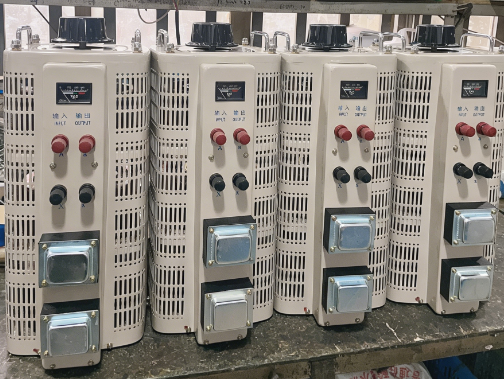
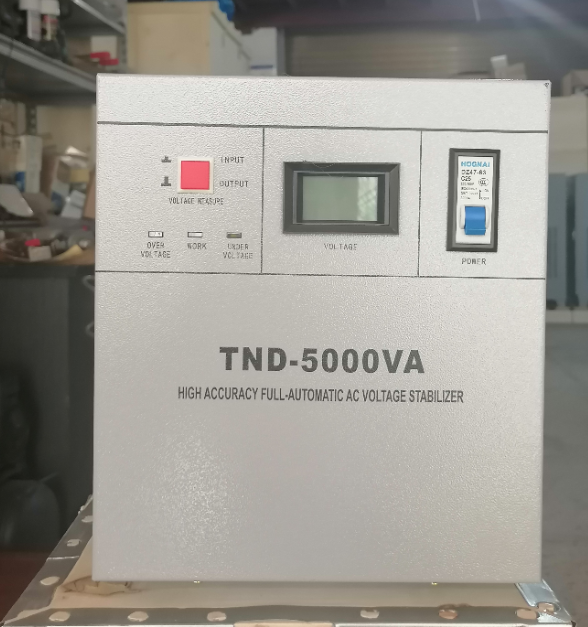
The TND Fully Automatic AC Voltage Stabilizer's working principle isn't complicated. A contact-type auto-transformer, a servo motor, and an automatic control circuit — three things working together. The sampling circuit watches output voltage. Once it deviates from the setpoint, the control circuit drives the servo motor, which moves the carbon brush along the regulator winding to a new position, pulling output voltage back to rated value. Input drops, compensation goes up; input rises, compensation goes down. Closed-loop operation, no one needs to watch it.
This structure isn't cutting-edge, but it's proven. The waveform isn't distorted — output matches input waveform with no additional distortion. For waveform-sensitive loads like audio equipment, medical instruments, and communication equipment, this matters more than many flashy specs.
Regulation speed is rated at under 1 second to complete adjustment when input voltage changes by 10%. For voltage changes caused by grid load fluctuations, this response speed is adequate. But for instantaneous spikes from lightning strikes or large equipment switching, the carbon brush mechanical structure can't keep up — that's its physical limit, and it's a job for a UPS or contactless stabilizer.
Capacities from 0.5kVA to 30kVA: Covering "Small Scenarios"
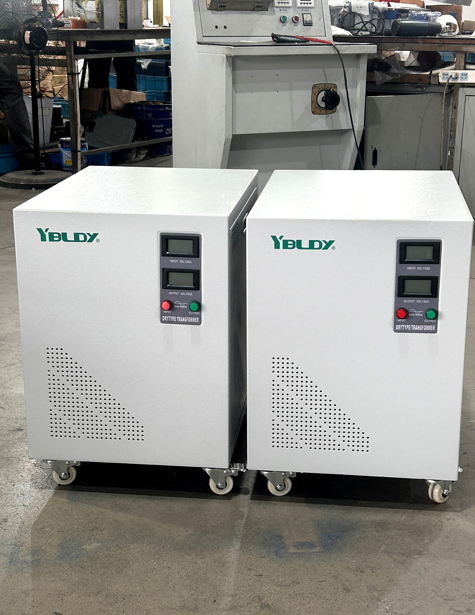
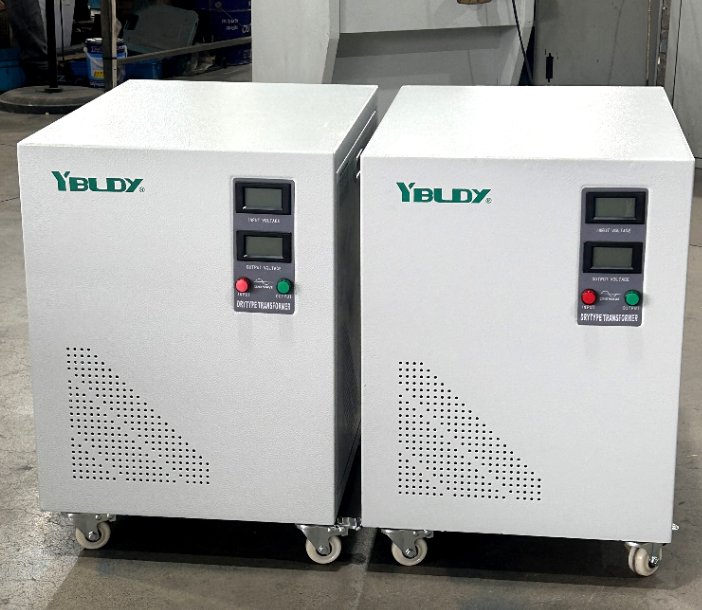
The TND Fully Automatic AC Voltage Stabilizer series capacity range is clear: 3, 6, 10, 15, 20, 30, 40, 50, 60, 70, 80, 90, and 100kVA. Units at 10kVA and below are typically benchtop or mobile; 15kVA and above are cabinet-type.
This capacity range means the TND isn't built for whole production lines or large equipment. Its position is at the endpoint: a precision instrument, a set of communication equipment, a lab workbench, a medical testing device. Some household users run air conditioners and refrigerators off one, but industrial scenarios are the main force.
Regulation accuracy is typically rated at 220V±4% from the factory, with some manufacturers achieving ±3%. Efficiency is rated above 90%. Insulation resistance must be no less than 5MΩ, with withstand voltage of 1500V/1 minute.
Protection Features: Overvoltage Yes, Undervoltage by Custom Order
The TND comes standard with overvoltage protection, typically tripping at 246V±4V — output is cut when voltage exceeds this value. Overcurrent protection is also standard.
One thing needs to be clear: undervoltage protection is usually not included on standard products and must be customized. The design logic: the TND's operating range already extends down to 160V, and at that point it's still working hard to compensate upward. Adding undervoltage protection would actually cut output while the unit could still be doing its job. But if site voltage might drop below 160V, or the equipment is extremely sensitive to undervoltage, the requirement needs to be raised at ordering.
Delay function is also optional — standard products don't include it. The point of delayed startup is to avoid transient grid fluctuations after power restoration, waiting for voltage to settle before supplying equipment. For unattended sites or high-value equipment, this feature is worth adding.
What to Look at When Specifying
Capacity is calculated from the load's actual power, but don't cut it too close. Motor loads draw high starting current — leaving adequate margin matters more than impressive specs. One easily overlooked point: when input voltage is below 198V, the TND's output capacity is derated — you don't get the full nameplate rating. For locations where grid voltage runs low year-round, this derating needs to go into the sizing calculation.
Confirm the input voltage range. Standard is 160V to 250V. If site voltage frequently drops below 160V, standard models won't reach it — you'll need a wide-range or custom unit.
Standard ambient temperature range is -5°C to +40°C; above 2000m altitude, derating is required. Leave adequate ventilation space — the carbon brush and regulator are components that generate heat, and cramming them into a cabinet corner does no favors for service life.
Applications Are Fairly Concentrated
The TND Fully Automatic AC Voltage Stabilizer's main battlefield is locations with low voltage and frequent fluctuations: township households, aging residential communities, the "last meter" next to precision equipment in factory workshops, school laboratories, and instrument power at medical clinics.
What it doesn't do is equally clear: it doesn't back up high-power motor starts, doesn't handle momentary outages or millisecond-level spikes, and doesn't provide electrical isolation. For scenarios needing those functions, the TND isn't the first line of defense.
When specifying, focus on three things: the actual minimum input voltage at the site, the load's starting current characteristics, and whether undervoltage protection and delay are needed. Let the carbon brush handle the rest.
Related News
Leave me a message
News Recommendations