
What is TSGC2 Three Phase Contact Voltage Regulator?
Some Jobs Can't Be Done by an Automatic Stabilizer
A voltage stabilizer does one thing: it holds the output steady. No matter what the grid does, the output stays put.
But sometimes, you don't want "steady." You want "adjustable."
Equipment commissioning needs a slow ramp from zero volts. Motor soft starting requires stepped voltage increases. Laboratory dielectric testing needs different voltage conditions. Aging tests require cycling products between 180V and 240V, over and over.
Automatic stabilizers can't do any of that. They lock onto one voltage and refuse to budge.
The TSGC2 three phase contact voltage regulator is built for exactly these jobs.
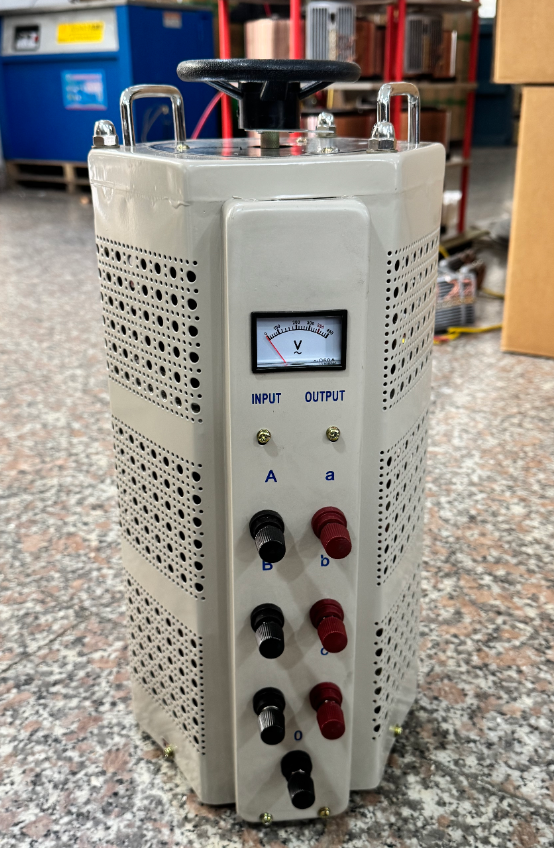
The TSGC2 is a three phase manual contact type voltage regulator — essentially an adjustable autotransformer.
Feed it 380V three phase input, and you get continuously adjustable output from 0V to 430V. No steps, no taps, no jumps. Turn the handwheel, and the voltage follows — smooth, stepless, linear.
It's not an electronic device. No chips, no programs, no firmware updates. Just a transformer, a handwheel, and a set of carbon brushes. As simple as it gets — and as reliable as it gets.
How TSGC2 Three Phase Contact Voltage Regulator Works
The TSGC2 uses a toroidal core with evenly wound coils. Three single phase regulators are connected in a star (Y) configuration, with the brush holders mounted on a common shaft.
The operating principle is straightforward: turn the handwheel, change the turns ratio.
Here's how:
Step 1 – Turn the wheel.
The operator rotates the handwheel, which turns the central shaft.
Step 2 – Brushes move.
Three brush holders on the shaft rotate together, sliding the carbon brushes across the polished surface of the windings.
Step 3 – Turns ratio changes.
As the brushes move to different positions, the number of effective turns changes — and the output voltage changes with them.
Step 4 – Voltage set.
Want 220V? Turn to that position. Want 380V? Turn a bit further. Smooth, continuous, no jumps.
No complicated control logic. No parameters to set. You turn it, and it gives you exactly what you ask for.
Features That Actually Matter
Clean waveform
The autotransformer design means the output waveform matches the input exactly — no added distortion. For testing, calibration, and precision experiments, clean power matters.
High efficiency
Autotransformers have low losses. Efficiency typically sits above 98%. Even at high power, it doesn't waste energy.
Compact and lightweight
Compared to an isolation transformer of the same capacity, the autotransformer uses less material, takes up less space, and weighs less. Easier to move, easier to install.
Strong overload capacity
It can handle momentary overloads without tripping or shutting down.
Built for continuous operation
No fragile electronic components. Natural air cooling. Run it all day if you need to.
Simple to maintain
The carbon brushes are the only wear parts. When they're worn, replace them — no circuit boards to troubleshoot, no firmware to reinstall.
Where Is TSGC2 Three Phase Contact Voltage Regulator Used?
The TSGC2 is used wherever manual three phase voltage adjustment is needed.
Laboratories and research
Equipment commissioning, voltage testing, dielectric strength experiments, teaching demonstrations. If you need to ramp voltage from zero, this is the standard tool.
Industrial production
Motor soft starting tests, product aging tests, production line voltage adjustment. Chemical, metallurgical, instrumentation, machinery, light industry — all use it.
Equipment repair and commissioning
When powering up repaired equipment for the first time, ramp the voltage slowly from zero to rated — much safer than hitting it with full voltage immediately.
Dimming, heating, speed control
Stage lighting dimming, heating element power control, small motor speed adjustment.
Public facilities
LED display screens, broadcast equipment, communication systems, electronic test equipment power supplies.
How to Choose the Right One
Two things matter most: capacity (kVA) and output voltage range.
Capacity – Add up the total power of everything you're connecting, then leave room for margin. Motors and compressors draw high startup current — size generously.
Standard TSGC2 capacities range from 1.5kVA to 45kVA. Common sizes: 3kVA, 6kVA, 9kVA, 15kVA, 20kVA, 30kVA. Not sure which one fits? Send your equipment list to Yibaling sales — they'll help you size it.
Output voltage range – Standard models take 380V input and deliver 0V 430V output. If you need higher output (e.g., 0 500V or 0 600V), custom versions are available.
Manual or motorised? – The TSGC2 is manual — you turn the handwheel. If you need remote control or automatic adjustment, motor driven versions are available on request.
Frequency – 50Hz/60Hz compatible. Works for export equipment too.
Installation environment – Indoor installation, well ventilated, free from corrosive gases and heavy dust.
How Is TSGC2 Three Phase Contact Voltage Regulator Different from an Automatic Stabilizer?
This comes up a lot. Here's the short answer:
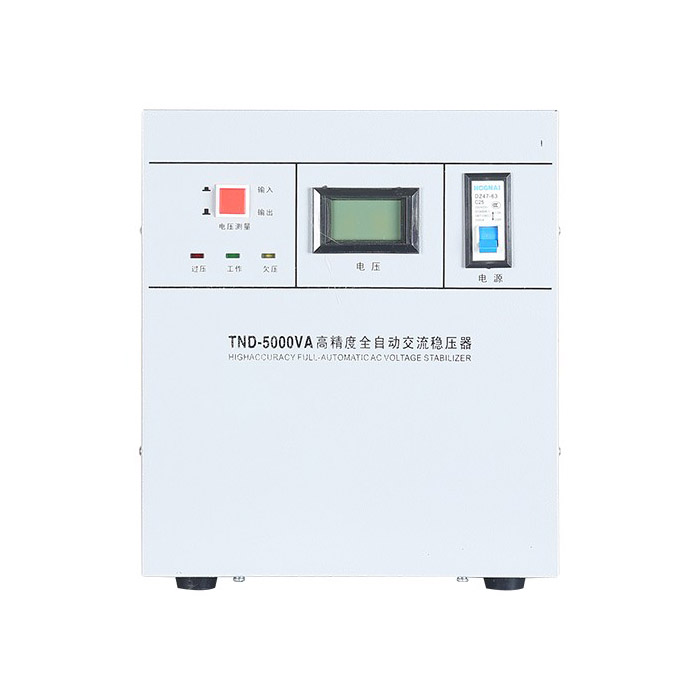
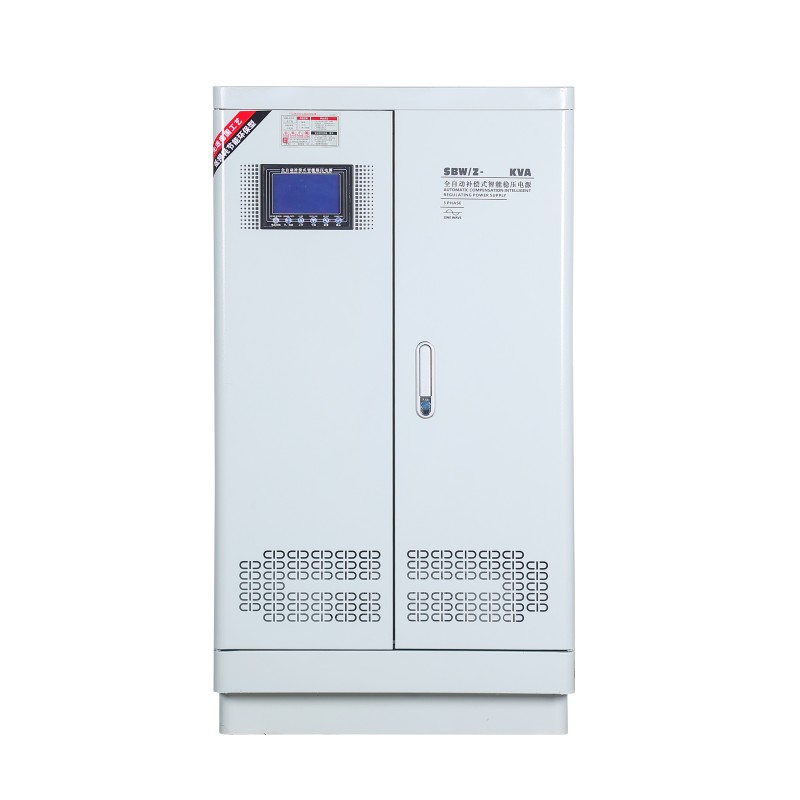
Automatic stabilizers (like TNS, SBW) : When the input voltage fluctuates, they adjust themselves — automatically holding the output steady. You don't have to do anything.
TSGC2 contact regulator : It doesn't care if the input fluctuates. Whatever output voltage you want, you turn the handwheel to that position. It does what you tell it to do, not what it decides on its own.
One "auto stabilises." One "manual adjusts." Different jobs, different tools — not replacements for each other.
Final Thoughts
The TSGC2 three phase contact voltage regulator isn't high tech. No chips, no screens, no internet connection.
It's a manual turn, voltage follows tool — simple and direct.
But in laboratories, on test benches, in aging rooms, in repair workshops — wherever you need human controlled voltage, starting from zero and ramping up slowly — it's still the most straightforward, most reliable tool for the job.Some jobs need automation. Some jobs need a handwheel.
Related News
- What ZSG Three-Phase Dry-Type Rectifier Transformer work?
- Which one is good S13 Oil-Immersed Distribution Transformer?
- How to choose JBK5 Machine Tool Control Transformer?
- How BK Machine Tool Transformer 220V works?
- Which one is good SBK Three-Phase Dry-Type Transformer?
- How to choose SBW Intelligent Servo Voltage Stabilizer?
Leave me a message