
What Is an S11 Distribution Transformer and Why Is It Important?
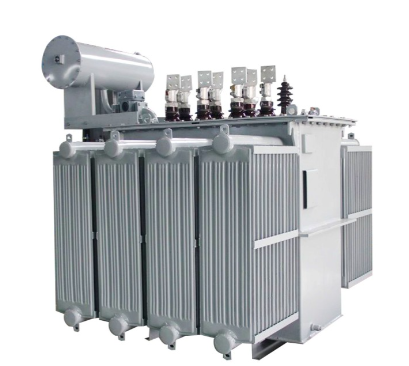
An S11 distribution transformer is a three-phase oil-immersed distribution transformer designed for stepping down medium-voltage power—typically 10kV or 6kV—to the low-voltage levels used by factories, buildings, and communities. Available in both fully sealed and conservator-tank types, it's a direct upgrade from the older S9 series, delivering lower losses and better operating economy.
What makes the S11 different from earlier models?
Compared to the S9 series, the S11 reduces no-load loss by about 30% and no-load current by 50%–70%. That's not a small improvement—it's a meaningful difference in operating cost, day after day, year after year.
Why does that matter?
Because transformers don't sleep. They run 24/7, 365 days a year. A transformer that wastes less power at idle saves money every single day. Over a 20 to 30 year service life, those savings add up to a substantial figure.
In short: the S11 delivers the reliability of an oil immersed transformer with significantly better efficiency than the models it replaced.
How an S11 Distribution Transformer Works
The operating principle is electromagnetic induction—the same as any transformer—but the S11 has several design improvements that boost efficiency and reliability.
Step 1 – The core
The core is made from high quality cold rolled grain oriented silicon steel, assembled with a 45° fully mitered lap joint structure. This design minimises magnetic resistance and eddy current losses. Some models use a wound core constructed with specialised equipment, creating a closed magnetic circuit with no butt joints—which further reduces losses and noise.
Step 2 – The windings
The transformer uses copper windings with improved insulation and active part materials. The coil support structure is designed for high stability, improving operational reliability.
Step 3 – The sealed tank
Instead of a traditional conservator tank, many S11 models use a corrugated oil tank with fully sealed construction. The corrugations expand and contract with oil temperature changes, automatically compensating for volume variation. This means the oil is permanently sealed away from air—preventing moisture ingress and slowing oil oxidation.
Step 4 – Cooling
Cooling is ONAN — Oil Natural Air Natural. No fans, no pumps, no extra moving parts. The transformer relies on natural convection through the corrugated tank walls to dissipate heat.
The result: a transformer that runs efficiently, stays sealed, and requires minimal maintenance.
Common Types and Ratings of S11 Transformers
The S11 series is available in a wide capacity range, typically from 10kVA up to 2500kVA.
| Capacity Range | Typical Application |
| 10 – 200 kVA | Small factories, rural distribution, residential areas |
| 250 – 630 kVA | Commercial buildings, medium industrial plants, substations |
| 800 – 1600 kVA | Large industrial facilities, high rise buildings |
| 2000 – 2500 kVA | Heavy industry, major infrastructure projects |
| Feature | Options |
| Primary voltage | 6kV, 10kV, 10.5kV, 11kV |
| Secondary voltage | 0.4kV (400V) |
| Tap range | ±5% or ±2×2.5% (no load tap changer) |
| Connection group | Yyn0 or Dyn11 |
| Tank type | Fully sealed (corrugated) or conservator tank |
| Core type | Stacked core or wound core |
| Parameter | Improvement |
| No load loss | Reduced by approximately 30% |
| No load current | Reduced by 50%–70% |
| Noise level | Reduced by 5 10dB |
Why S11 Distribution Transformers Matter
Because a transformer that wastes less power and lasts longer is a transformer that saves money.
Here is what makes the S11 a solid choice for distribution networks:
1. Reduced no load loss
The step lap core and high grade silicon steel reduce no load loss by about 30% compared to the S9 series. For a transformer that runs 24/7, that's a real and measurable saving.
2. Reduced no load current
No load current is reduced by 50%–70% , improving power factor and reducing upstream losses.
3. Fully sealed construction
The corrugated tank is fully sealed—no breather, no conservator. Oil does not contact air, which means insulating oil ages more slowly, preserving its dielectric strength over the transformer's life.
4. Lower noise
Noise levels are reduced by 5 10dB compared to earlier designs, making the S11 more suitable for installation near residential areas.
5. Long service life
Because the oil is sealed from air and moisture, the transformer's insulation system degrades more slowly. The S11 is designed for 20 30 years of service with minimal maintenance.
6. Low maintenance
No oil sampling, no top up, no conservator maintenance. The fully sealed design means routine maintenance is largely limited to external cleaning and periodic inspection.
7. Wide application range
S11 transformers are suitable for factories, mines, petrochemical plants, industrial and agricultural distribution, and power and lighting applications.
Choosing the Right S11 Transformer
Selecting an S11 transformer requires matching capacity, voltage, and environmental conditions to your application.
Step 1 — Determine your load
Add up the power consumption of all equipment that will be connected. Apply a safety margin—typically 20 30% for future expansion.
S11 standard ratings: 10, 20, 30, 50, 63, 80, 100, 125, 160, 200, 250, 315, 400, 500, 630, 800, 1000, 1250, 1600, 2000, 2500 kVA.
Step 2 — Specify primary and secondary voltages
| Parameter | Typical Value |
| Primary voltage | 6kV, 10kV, 10.5kV, 11kV |
| Secondary voltage | 0.4kV (400V) |
| Tap range | ±5% or ±2×2.5% (no load tap changer) |
| Frequency | 50Hz |
Step 3 — Choose connection group
Dyn11 — recommended for most applications. The delta high voltage connection provides a path for harmonic currents and improves short circuit capacity.
Yyn0 — simpler, but less suitable for unbalanced loads.
Step 4 — Check installation environment
| Condition | Requirement |
| Altitude | ≤1000m |
| Ambient temperature | -25°C to +40°C |
| Installation | Indoor or outdoor; avoid corrosive gas and heavy pollution |
| Humidity | Standard outdoor conditions |
Step 5 — Consider tank type
Fully sealed (corrugated tank) — recommended for most applications. No oil air contact, slower oil aging, minimal maintenance.
Conservator tank — traditional design with oil conservator and breather. Requires periodic oil level checks and maintenance.
Step 6 — Confirm protection accessories
For critical applications, consider:
Gas relay and pressure relief device (for larger units)
Temperature monitor with remote alarm contacts
Buchholz relay for fault detection
Final Thoughts
The S11 oil immersed distribution transformer represents a meaningful efficiency improvement over earlier S9 and S10 models. With no load loss reduced by about 30% and no load current reduced by 50%–70%, it delivers lower operating costs and better reliability than the models it replaced.
What makes the S11 particularly practical is its fully sealed construction. By isolating the oil from air and moisture, the sealed tank design slows oil aging, extends insulation life, and virtually eliminates routine maintenance. For outdoor installations in remote locations, this is a significant advantage.
The S11 is not the newest transformer on the market. It has been superseded in efficiency by S13, S20, and newer designs. But it remains a proven, reliable, cost effective workhorse for millions of installations worldwide.
For projects where budget and reliability are both important—upgrading an older transformer, replacing a failed unit, or building a new distribution network with realistic cost constraints—the S11 is still a solid, sensible choice.
It does not have the lowest losses of any transformer ever made. But it has significantly lower losses than the S9 it replaced—and that difference shows up on the electricity bill, month after month, year after year.
Related News
- What ZSG Three-Phase Dry-Type Rectifier Transformer work?
- Which one is good S13 Oil-Immersed Distribution Transformer?
- How to choose JBK5 Machine Tool Control Transformer?
- How BK Machine Tool Transformer 220V works?
- Which one is good SBK Three-Phase Dry-Type Transformer?
- How to choose SBW Intelligent Servo Voltage Stabilizer?
Leave me a message