
Which one is good S13 Oil-Immersed Distribution Transformer?
One Transformer Determines How Much Trouble the Local Power Station Deals With
Anyone who's spent time at a grassroots power supply station knows that distribution transformer selection isn't about picking whichever number looks best on the spec sheet. A transformer sits on a pole and runs for fifteen or twenty years. When something goes wrong, it means outage, climbing the pole, calling a crane — and how much trouble that involves is directly tied to the transformer's reliability. The S13 series oil-immersed distribution transformer is a product widely chosen under exactly this logic. It's not the newest model, but for this capacity range and this application, it's a proven, practical option.
Stacked Core or 3D Wound Core: Get This Straight First
The S13 Oil-Immersed Distribution Transformer comes in two main structures: traditional stacked core and 3D wound core. Stacked core is the mainstream form of the S13 series, using 0.23mm high-permeability grain-oriented silicon steel with fully inclined lap joints. The 3D wound core arranges three limbs in an equilateral triangular configuration, with symmetrical magnetic paths and continuously wound silicon steel that produces no waste — material utilization can reach 100%.
The loss difference between the two is real. For the same capacity, the S13-M·RL 3D wound core saves more than 20% on silicon steel compared to the S13 stacked core, reduces no-load current by over 50%, and cuts noise by 4-6dB(A). But 3D wound core manufacturing is more complex and the price is higher. Which to choose depends on project budget and sensitivity to noise.
How Much the Losses Come Down: The Numbers
Compared to the previous-generation S11, the S13 reduces no-load losses by an average of 20%-30%. Take the S13-100/10 as an example: no-load loss 150W, load loss 1580W/1500W (for Dyn11 and Yyn0 vector groups respectively). Over a full year of operation, the electricity cost difference from this reduction is not a small sum.
On noise, the S13-M.RL series runs 7-10dB(A) lower than S11 units of the same capacity. For distribution transformers installed near residential areas, this difference directly determines whether anyone files a complaint.
Fully Sealed Structure: Fewer Pole Climbs
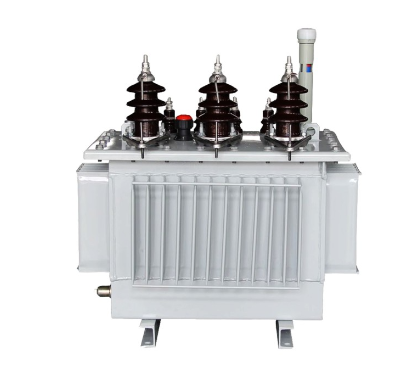
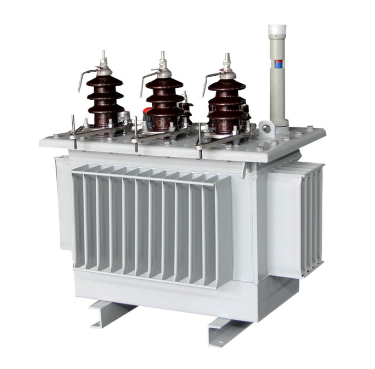
The S13 Oil-Immersed Distribution Transformer uses a fully sealed corrugated tank structure, isolating transformer oil from outside air and slowing oil aging considerably. The corrugated fins themselves handle heat dissipation and breathing — no oil conservator needed, no regular oil level checks. For a power supply station, one fewer component to inspect means one less workload.
Windings are full copper, with a multi-layer cylindrical high-voltage structure. Ampere-turn distribution is balanced, leakage flux is small, and short-circuit withstand capability is stronger than older models. Coils and core are vacuum-dried, and transformer oil is vacuum-filtered and vacuum-filled, ensuring insulation strength.
Capacity and Voltage: Choose as Needed
The S13 Oil-Immersed Distribution Transformer covers capacities from 30kVA to 1600kVA, with standard models including 50, 63, 80, 100, 125, 160, 200, 250, 315, 400, 500, 630, 800, 1000, 1250, and 1600kVA. The high-voltage side is typically 10kV with a tap range of ±5% or ±2×2.5%, and the low-voltage side is 0.4kV. Vector groups Yyn0 or Dyn11 are available.
De-energized tap changing means the transformer must be powered down to adjust taps — a reflection of its positioning. Distribution transformer loads change relatively slowly, so seasonal adjustment once or twice a year is enough. On-load tap changing isn't needed.
An Unavoidable Reality: New Standards Are Here
The 2026 energy efficiency standard GB 20052-2024 has been implemented, tightening both no-load and load loss limits by roughly 10%-15%. The S13 now only meets Grade 3 efficiency. Under the new rules, new construction projects and government procurement are already advised against selecting S13, and mainstream selection is shifting toward S20 and S22.
But that doesn't mean the S13 has no market. For renovation projects with limited budgets, temporary power scenarios, or industrial users without hard efficiency grade requirements, the S13 remains a cost-controllable option. Before purchasing, just confirm the local energy efficiency access requirements — don't wait until the equipment arrives to discover it's non-compliant.
Installation and O&M: Nothing Fancy
Oil-immersed transformer installation and maintenance have been standardized for decades. Foundation pouring, hoisting into place, oil level checks, reliable grounding — these procedures become familiar after one go. The S13's fully sealed structure eliminates the oil conservator and moisture absorber. Daily inspections mainly check for leaks in the corrugated fins, abnormal temperatures, and discharge traces on bushings.
What really needs attention is load matching. The S13 has limited overload capacity, and sustained operation above rated capacity accelerates insulation aging. Keeping distribution transformer load rate in the 60%-70% range is a healthy zone — leaving margin to handle seasonal peaks and temporary loads.
Related News
- What ZSG Three-Phase Dry-Type Rectifier Transformer work?
- How to choose JBK5 Machine Tool Control Transformer?
- How BK Machine Tool Transformer 220V works?
- Which one is good SBK Three-Phase Dry-Type Transformer?
- How to choose SBW Intelligent Servo Voltage Stabilizer?
- Where SCB13 Dry-Type Transformer Fit in Urban Grids?
Leave me a message