
How BK Machine Tool Transformer 220V works?
When Control Power Fails, the Whole Machine Stops
Spend enough years in machine tool electrical maintenance and you notice a pattern. Main circuit faults usually mean a trip or an alarm — clear direction for troubleshooting. Control circuit problems are different. They show up as scattered, puzzling symptoms: a contactor that won't pull in, indicator lights flickering randomly, a PLC that occasionally resets. You chase it for hours and find nothing obvious. Then you look at the control transformer and realize the capacity was undersized, or the winding insulation has aged. The BK series machine tool control transformer exists specifically for this kind of "last meter" power problem.
From 25VA to 5kVA, Covering the Routine Needs of Machine Tool Control Circuits
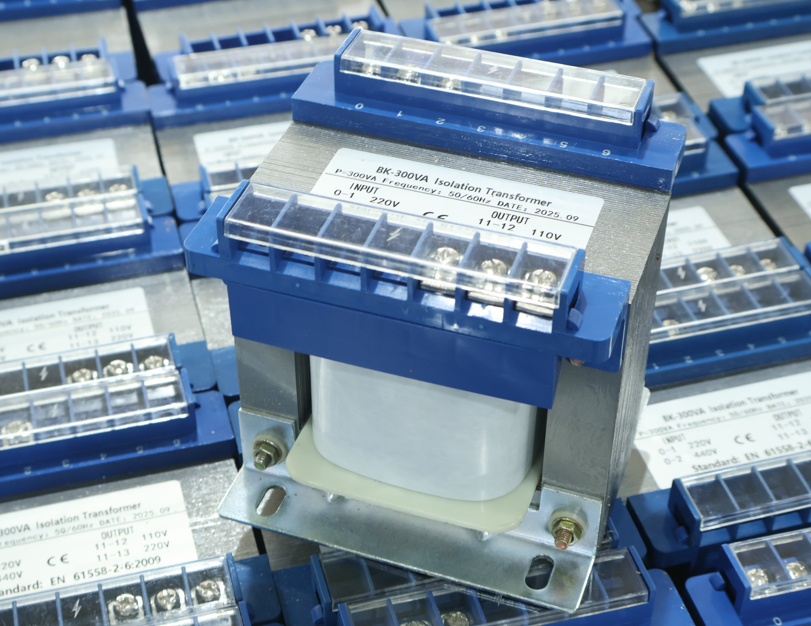
The BK Machine Tool Transformer 220V series starts at 25VA, with standard models covering 50VA, 100VA, 150VA, 200VA, 250VA, 300VA, 400VA, 500VA, 700VA, 1000VA, and going up to 1500VA, 2000VA, 3000VA, even 5000VA. This range covers the typical loads in a machine tool control circuit: contactor and relay coils, PLC power modules, solenoid valves, indicator lights, and local lighting.
Input voltage is usually 220V or 380V, and dual-input taps are available — whether the site runs 220V or 380V, you wire accordingly. Output options are broader: 6V, 12V, 24V, 36V, 110V, 127V, 220V are all doable, and multi-winding, multi-output versions can be customized. It's common for one transformer to feed lighting, signals, and control circuits simultaneously. Multiple outputs save the cabinet space that a second transformer would occupy.
Winding Material and Core Process Determine Durability
Machine tool control transformers don't work in harsh environments, but the load characteristics aren't friendly. Contactor and relay coils are inductive loads — inrush current at pull-in is high, and there's back EMF at break. How the BK series performs here depends largely on winding and core materials.
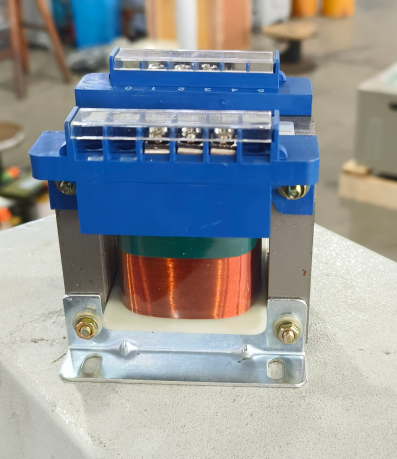
Copper windings are the baseline. Pure copper enameled wire offers significantly better conductivity and thermal stability than aluminum, especially under frequent pull-in and break cycles — copper's temperature rise is more reassuring. On the core, stacked cold-rolled silicon steel laminations are standard practice. High-permeability material means low no-load current and low heat, so it doesn't waste power and generate heat while sitting idle for long periods.
Insulation treatment matters too. High-temperature epoxy impregnation, flame-retardant bobbins, layered insulation — these things show no difference in routine use, but when summer heat hits or the load runs heavy, poorly insulated products start acting up. Class B insulation is the baseline; Class F is available for demanding applications.
Terminal and Structural Details You Only Appreciate After Using Them
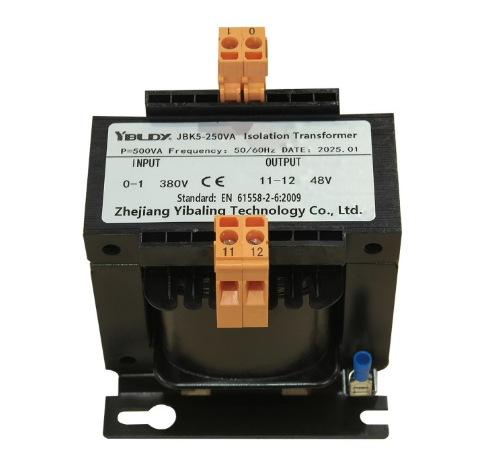
The BK Machine Tool Transformer 220V series uses a shell-type structure, vertical mounting, with terminals on the outside — wiring and maintenance without removing the enclosure. Thickened silver-plated copper terminals have low contact resistance and resist heat and oxidation over long runs. This detail makes a noticeable difference when cabinet temperatures run high.
On mounting dimensions, small-capacity models from 25VA to 50VA have mounting hole spacing of roughly 65×50mm, with overall dimensions around 78×80×77mm — they fit in a corner of the control cabinet. Medium-capacity models from 500VA to 1000VA have spacing around 110×100mm, with overall dimensions held within roughly 150mm square. When cabinet space is tight, these dimensions matter more than any other number on the spec sheet.
Applications and Selection Notes
BK Machine Tool Transformer 220V series applications are clear: machine tool control electrical power, local lighting power, indicator light power. Compliant with JB/T5555 industry standards, they're a standard choice for machine tools and mechanical equipment.
There are a few traps to avoid when specifying. Capacity isn't simply the sum of all load rated powers — contactor inrush current can be several times rated value, so leaving adequate margin matters more than impressive specs. For multi-winding output models, don't exceed total capacity when all windings carry load simultaneously. The transformer is designed for total capacity, not for every winding running at full load. Also, if the equipment itself requires electrical isolation, the BK series uses isolated windings — primary and secondary are separate, so that requirement is met.
Before installation, confirm grid voltage matches the transformer nameplate, tighten terminals, and ensure reliable grounding. Let the transformer handle the rest.
Related News
- What ZSG Three-Phase Dry-Type Rectifier Transformer work?
- Which one is good S13 Oil-Immersed Distribution Transformer?
- How to choose JBK5 Machine Tool Control Transformer?
- Which one is good SBK Three-Phase Dry-Type Transformer?
- How to choose SBW Intelligent Servo Voltage Stabilizer?
- Where SCB13 Dry-Type Transformer Fit in Urban Grids?
Leave me a message