
What is TNS Series Automatic Voltage Stabilizer?
If you run a shop floor with CNC machines, or you manage a medical imaging suite, or you're keeping a telecom base station online, you know the feeling. A voltage sag hits—just for a second—and suddenly your most expensive equipment starts throwing errors. Or worse, it shuts down mid-cycle. You lose the workpiece, you lose the data, you lose the hour it takes to get everything calibrated again.
The TNS series fully automatic AC voltage stabilizer isn't new, and it isn't fancy. It doesn't have Bluetooth, it won't connect to your cloud dashboard, and it's not going to win any design awards. But it does one thing very well, day in and day out: it keeps three-phase power where it needs to be. And for a lot of people, that's all that matters.
Three-Phase Independence, Not Compromise
Here's the thing about three-phase power that people don't always appreciate until something goes wrong: voltage doesn't always drop evenly across all three lines. One phase might be sitting pretty at 220V while another is limping along at 190V, and the third is somewhere in between. It happens all the time, especially in industrial parks where heavy loads are starting and stopping constantly, or in rural areas where the grid is long and underfed.
A lot of stabilizers on the market treat the whole three-phase system as one big block. They look at one phase, or they look at an average, and then they adjust everything the same way. That's fine if the problem is perfectly symmetrical. But it's not fine when one phase is dragging and the others are fine—because now you're either overcorrecting two phases while still undercorrecting the third, or you're leaving the equipment exposed on that one bad line. Either way, your sensitive loads are still at risk.
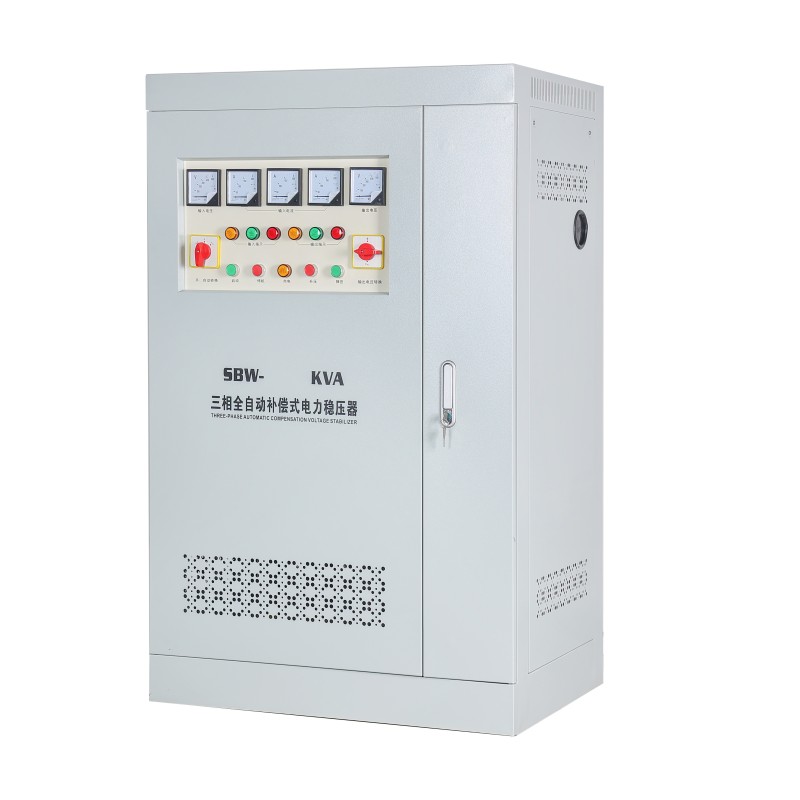
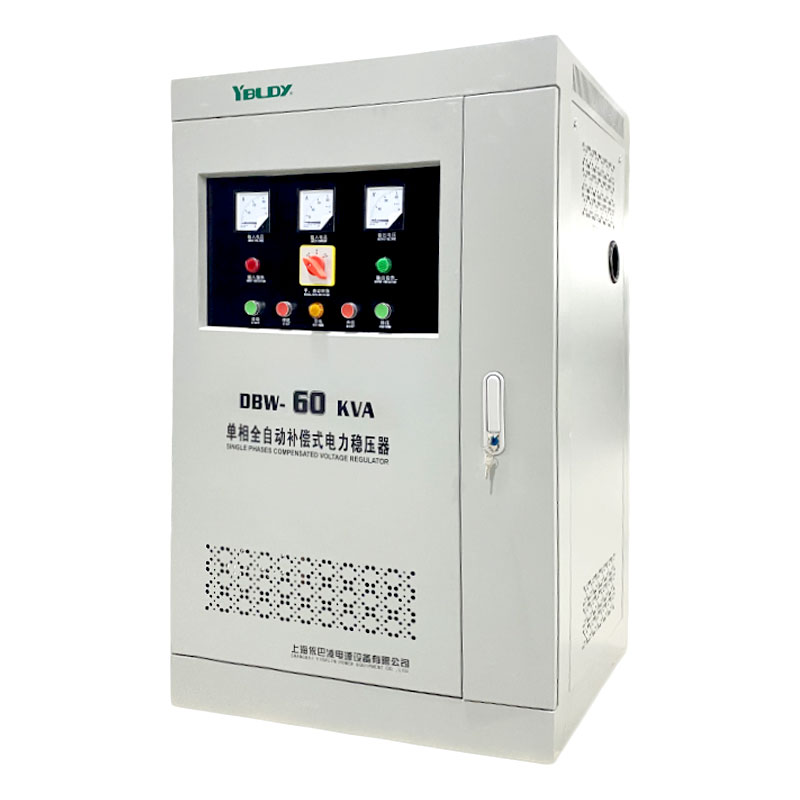
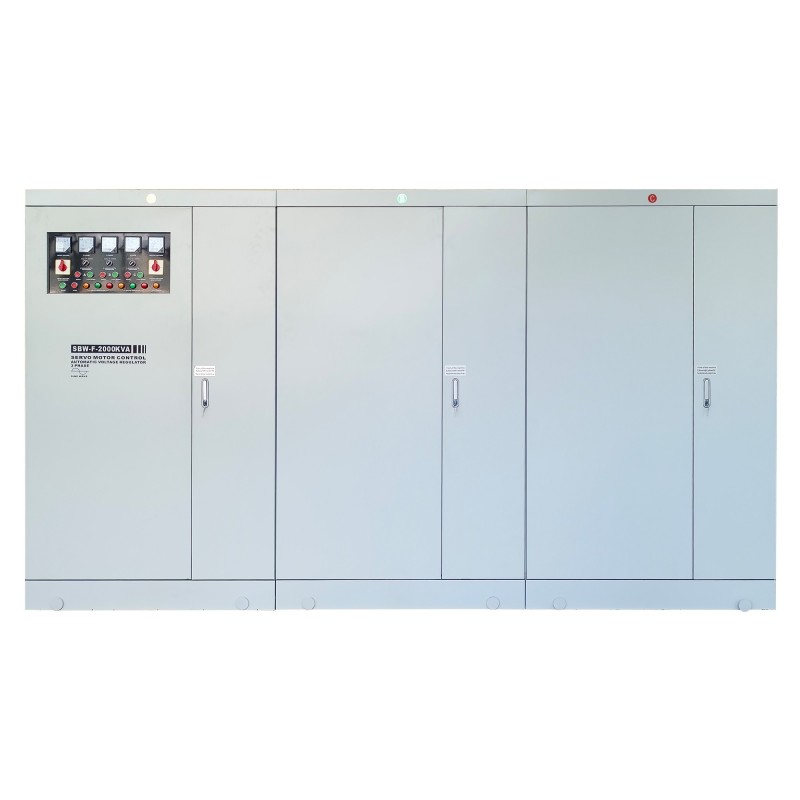
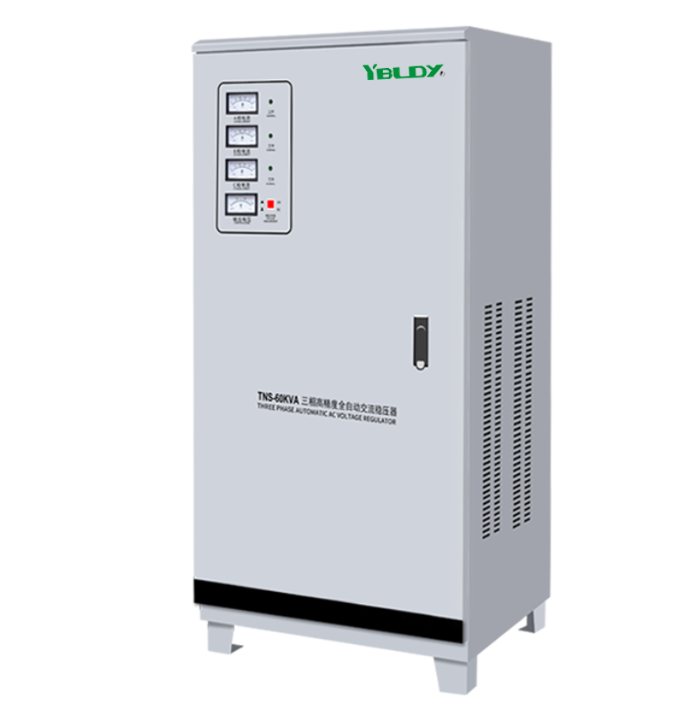
The TNS series takes a different approach, and this is where it really earns its keep. It's essentially three single-phase SVC regulators working independently inside the same cabinet, each with its own control circuit, each adjusting its own phase as needed. Think of it as three dedicated line workers instead of one supervisor trying to do three jobs at once. The input is three-phase four-wire, the output is configurable as four-wire or three-wire depending on your needs, and you get three separate ammeters right on the front panel to keep an eye on current draw per phase at a glance. That's not a luxury feature—that's a diagnostic necessity when you're trying to figure out why one line keeps tripping.
The numbers speak for themselves on paper, but they mean more when you think about what they represent in the real world: input range from 270V to 456V, output locked at 380V ±3%. That's a wide enough window to handle most of what a shaky grid can throw at it. If your incoming voltage is all over the map, this unit will catch it, straighten it out, and send clean power downstream without making a fuss.
What the Tech Actually Does
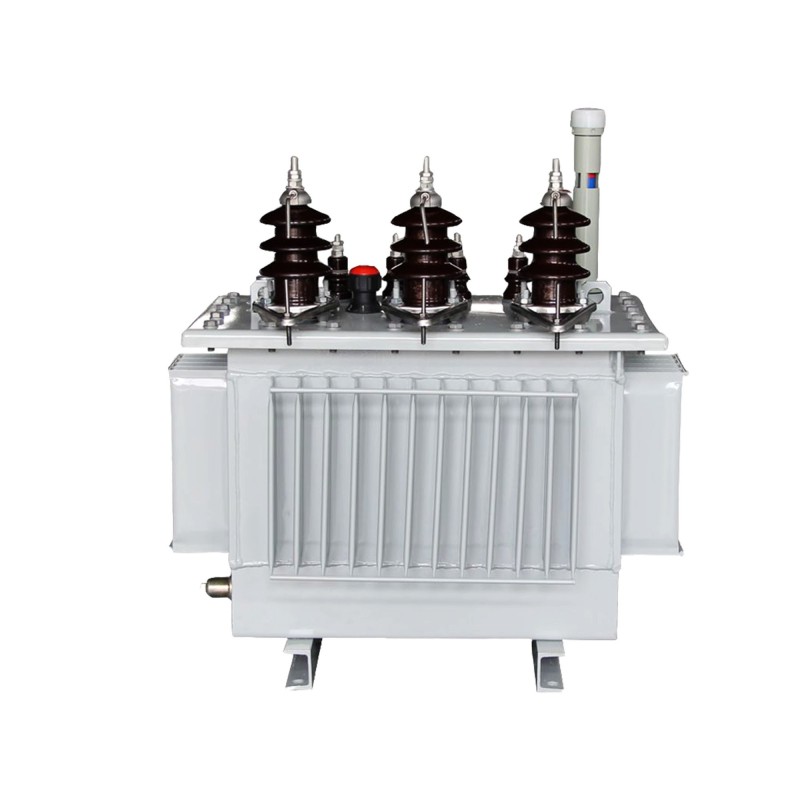
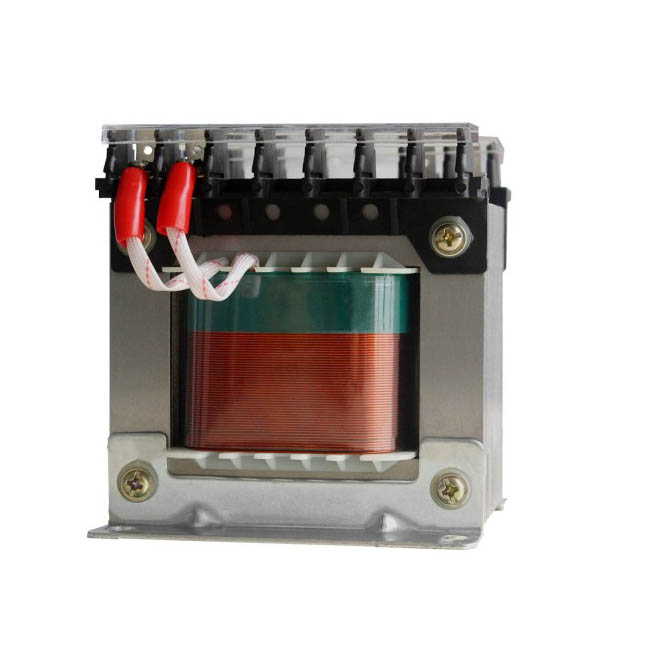
Pop the cover off a TNS unit and you won't find a lot of mystery inside. The core is a servo motor driving a carbon brush across a contact voltage regulator—a big toroidal transformer with a carefully polished winding surface. It's not a new idea; people have been doing servo-driven voltage correction for decades. But there's a reason it's still around: it works, it works reliably, and when it does eventually need attention, any electrician with basic skills can figure it out.
Here's how it actually plays out in operation. The control circuit constantly monitors the output voltage. When it detects drift—say, the line drops from 380V to 360V because a large motor kicked on down the street—it sends a signal to the servo motor. The motor turns, the carbon brush slides along the polished winding of the regulator, and the turns ratio changes just enough to bring the output back to where it belongs. This happens smoothly, continuously, and without the abrupt switching you get from relay-based systems that snap in and out.
Response time is under one second for a 10% input change. That's fast enough to catch most sags and swells before they can cause a breaker to trip, a controller to fault, or a drive to reset. Efficiency is north of 95%, with some models hitting 98% depending on the configuration and load. And because it's a purely electromechanical correction—no semiconductor switching, no chopping up the waveform—there's no added harmonic distortion. What comes out is a clean sine wave, essentially the same shape as what went in, just at the right voltage. For equipment like CNC controllers, PLCs, and medical imaging devices that are sensitive to waveform quality, that's a big deal.
One feature that doesn't get talked about enough but matters immensely to facility managers: the bypass switch. If the unit ever needs maintenance or replacement, you can manually throw the bypass and route power straight through, bypassing the stabilizer entirely. That means your equipment stays running while the unit gets serviced. No downtime, no middle-of-the-night panic calls, no explaining to the production manager why the line has been dark for two hours. That's the kind of detail that saves headaches at 2 AM, and it's built right into the standard configuration.
Built for the Real World
The TNS Series Automatic Voltage Stabilizer finds its way into a lot of different places, and that's because voltage problems don't discriminate. You'll see them in factories running CNC machines, stamping presses, injection molding equipment, and conveyors. You'll find them in hospitals backing up MRI machines and CT scanners, where a voltage fluctuation could mean repeating a scan or worse, damaging a tube that costs more than a car. They're in telecom sites keeping base stations online, in printing houses running massive offset presses, in elevators, in laser cutters, in testing labs. They're the kind of equipment that nobody notices when it's working right—and everybody notices immediately when it's not.
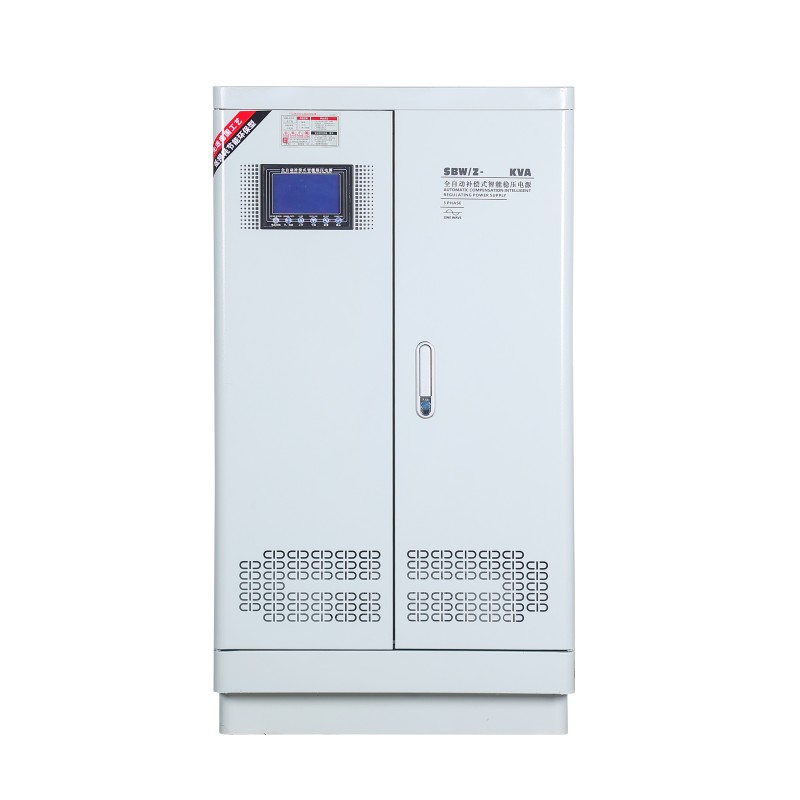
The physical build is suited for that kind of life. Operating temperature range is -5°C to 45°C, humidity up to 90% non-condensing, with IP20 protection for indoor installation. It's not sealed against weather, and it's not meant for outdoor use without additional enclosures, but inside a clean electrical room or a machine shop, it'll hold up fine. Forced air cooling kicks in to keep things from getting too warm, and the carbon brushes are designed for long life before replacement is needed.
Protection features are comprehensive because this unit is often the last line of defense before expensive equipment. You get overvoltage protection, undervoltage protection, overload protection, short circuit protection, overheating protection, phase failure protection, and phase sequence protection. If the output hits 426V±7V, the unit cuts off immediately to protect whatever's downstream. It also has delayed start and automatic restart capabilities, which are particularly useful after a power interruption—nobody wants all the motors on the floor trying to start simultaneously the moment power comes back.
Capacities range from 3kVA all the way up to 100kVA for standard models, with higher capacities available on custom order. If your application needs something outside the box—a different input voltage range, a specific output voltage, a different display configuration, or a special enclosure—most suppliers can accommodate with a lead time.
The Bottom Line
The TNS Series Automatic Voltage Stabilizer isn't trying to be clever. It's not digital, it doesn't have a touchscreen or an Ethernet port, and it's absolutely not going to send you push notifications about its health status. What it does is straightforward, mechanical, and proven: it keeps the lights on and the machines running when the grid gets sloppy.
If you're running single-phase loads, this isn't your unit—the SBW series or a smaller SVC unit would make more sense. But if you're running three-phase equipment that can't afford unplanned downtime, if you've got loads that are sensitive to phase imbalance, or if you're just tired of resetting breakers and recalibrating machines after every voltage dip, the TNS Series Automatic Voltage Stabilizer is worth a serious look.
It's not sexy. It's not smart. But it's solid, it's affordable relative to the damage it prevents, and it will outlast most of the equipment it's protecting. In a world where everyone wants to sell you something connected and cloud-enabled and subscription-based, there's something refreshing about a piece of gear that just does its job, quietly, for years on end.
About the Manufacturer
The TNS Series Automatic Voltage Stabilizer is manufactured by a range of suppliers, many based in Zhejiang, China, with CE certification and international safety standards compliance. These are established production lines with years of refinement behind them. Custom configurations are available for customers with specific application requirements.
Related News
- What ZSG Three-Phase Dry-Type Rectifier Transformer work?
- Which one is good S13 Oil-Immersed Distribution Transformer?
- How to choose JBK5 Machine Tool Control Transformer?
- How BK Machine Tool Transformer 220V works?
- Which one is good SBK Three-Phase Dry-Type Transformer?
- How to choose SBW Intelligent Servo Voltage Stabilizer?
Leave me a message